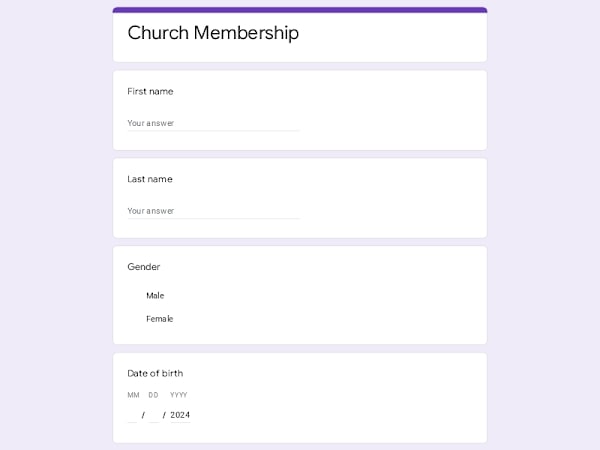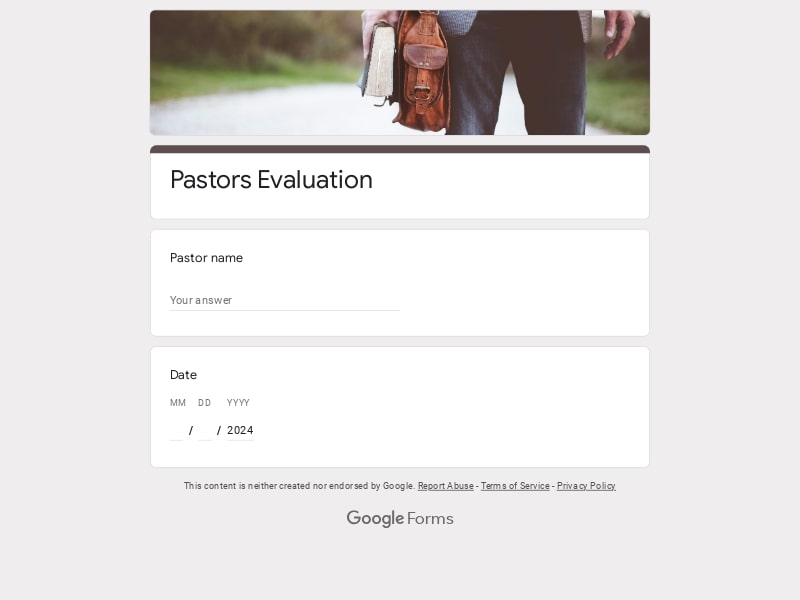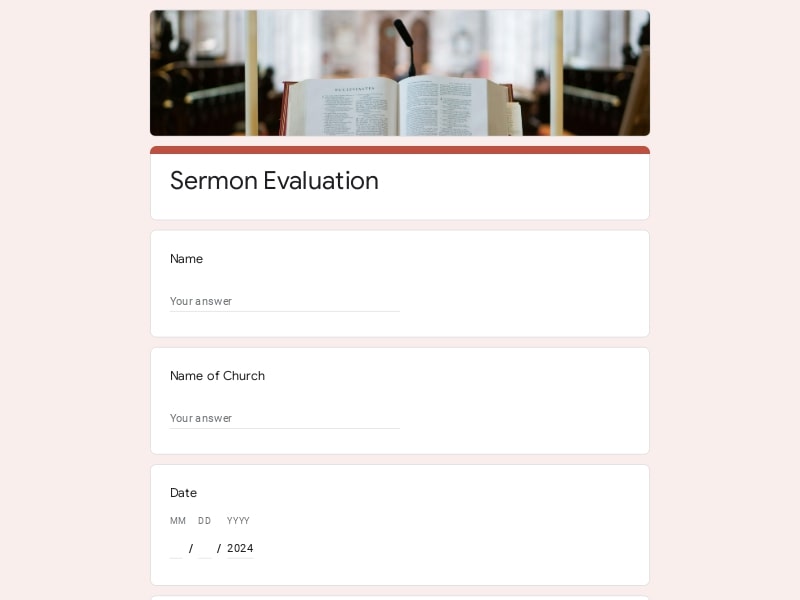

These ready-to-use Google Forms templates let any church, ministry, or individual collect prayer requests online — with structure, privacy options, and zero setup time. Pick a template, open it in Google Forms, and start receiving requests in minutes.
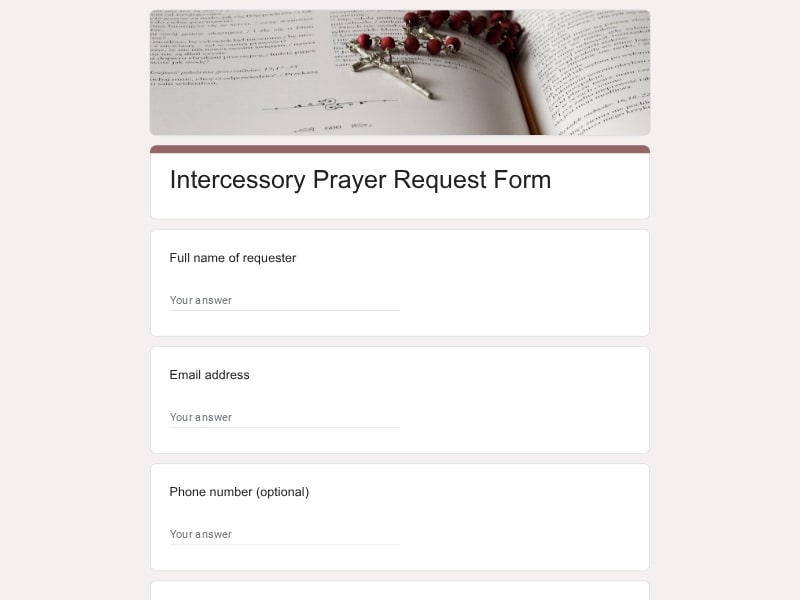 Preview
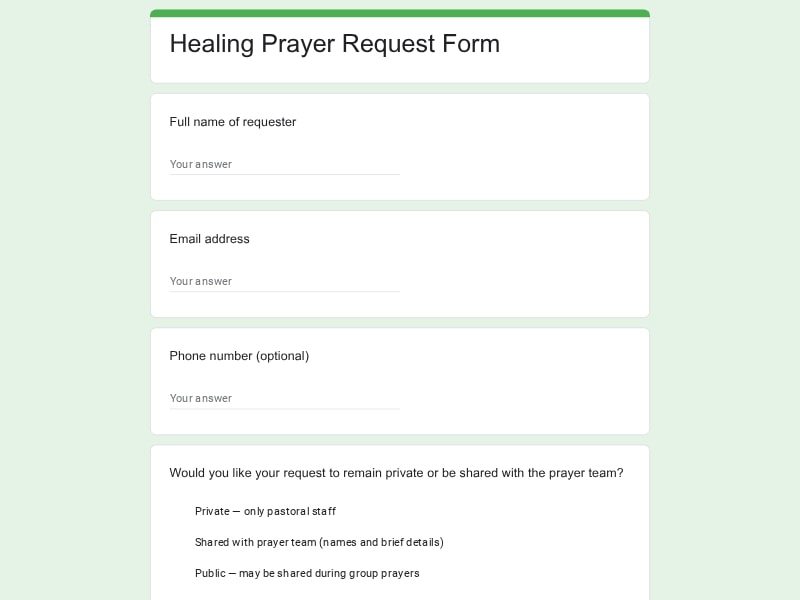 Preview
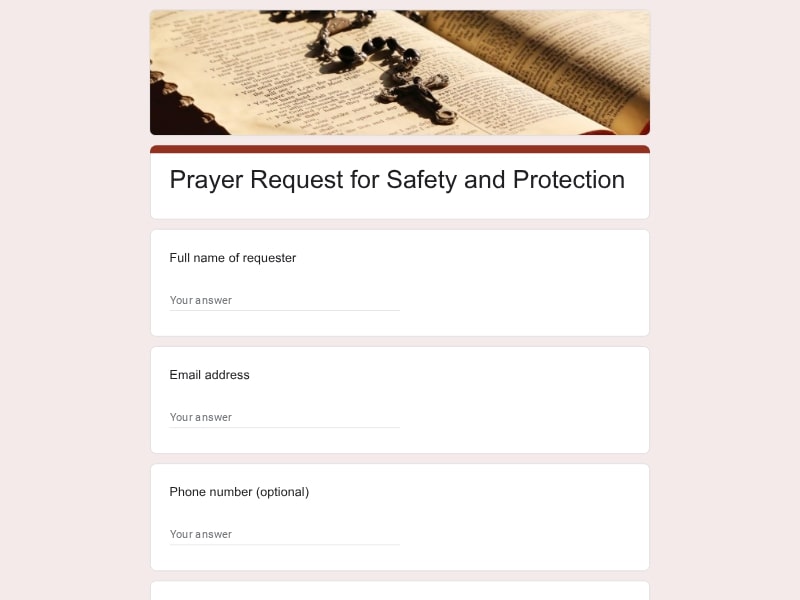 Preview
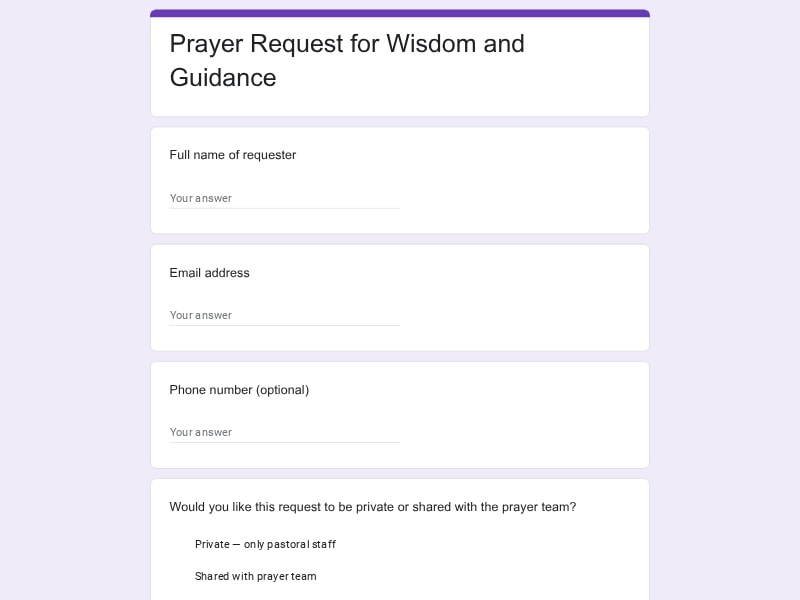 Preview
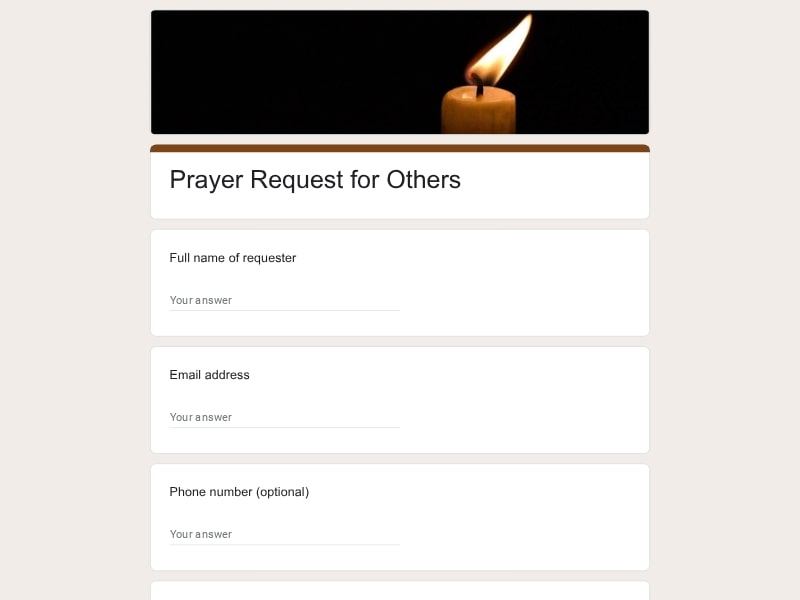 Preview
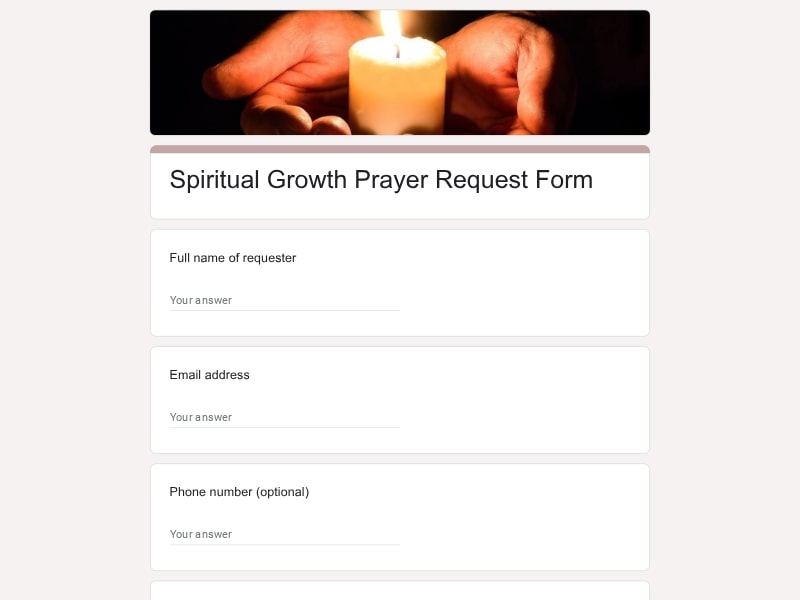 Preview
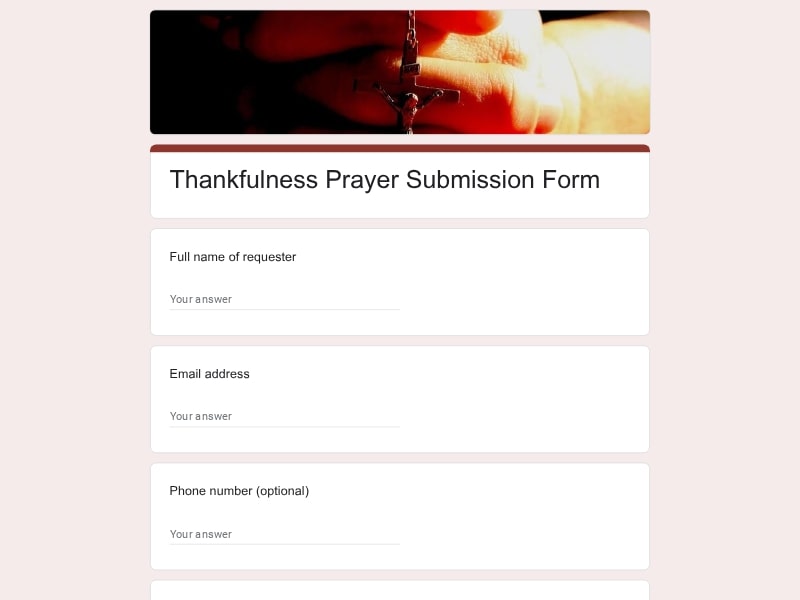 Preview
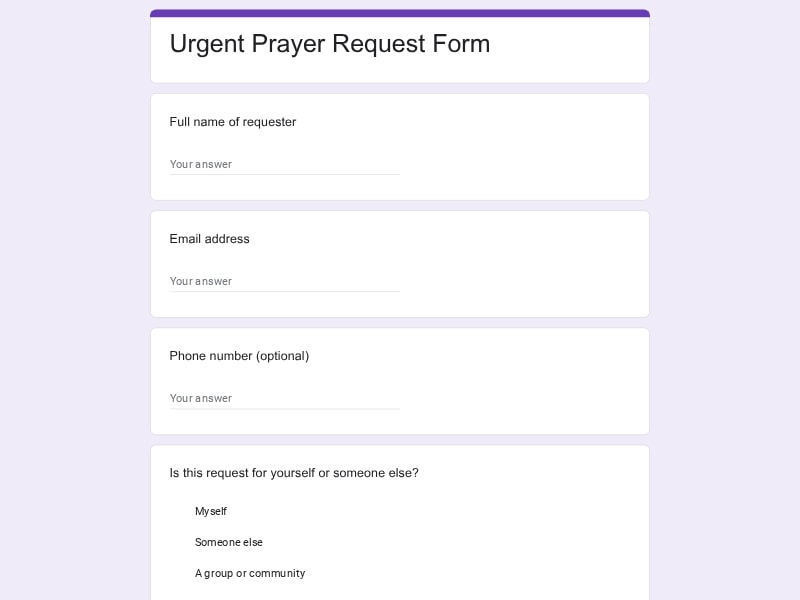 Preview
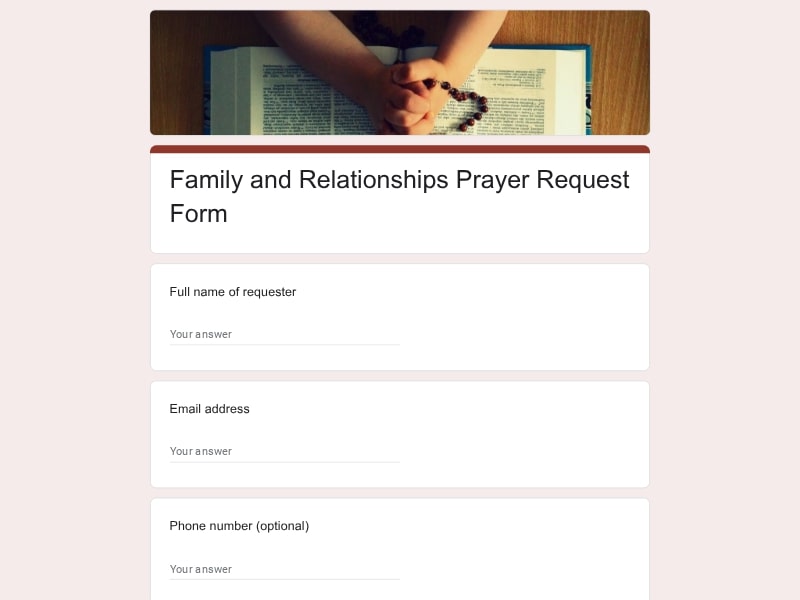 Preview
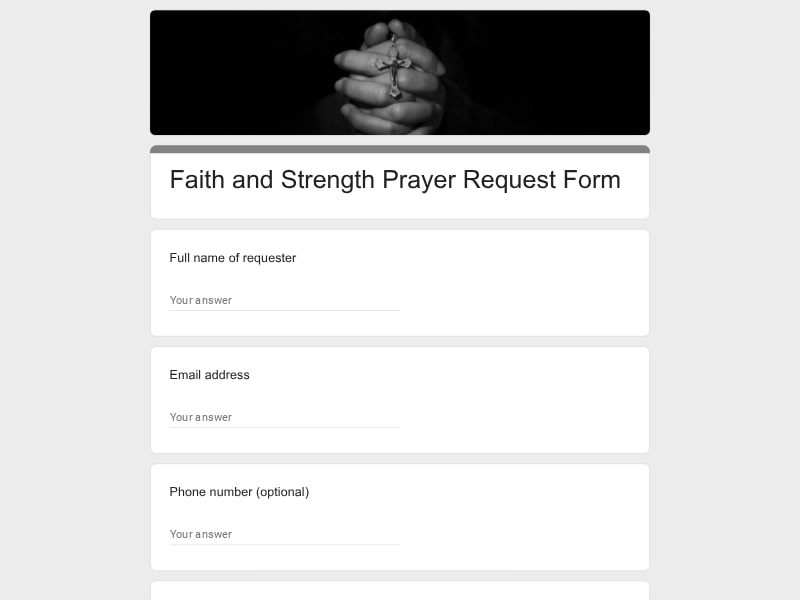 Preview
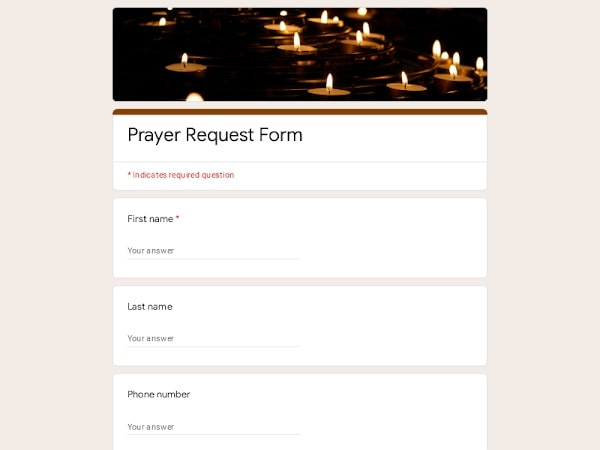 Preview
A prayer request form is a structured document that collects the name, contact details, and specific prayer needs of a person seeking spiritual support from a church, community group, or prayer team. Online, these forms serve as a confidential channel between someone in need and those who pray — used by churches to organize weekly intercession lists, by Christian schools to support students and families, by small groups to stay connected between meetings, and by ministries running anonymous prayer lines where no one has to share publicly to be heard.
Most request forms either ask too little and lose context, or overwhelm the person submitting. A thoughtfully designed form guides someone through what to share — gently, without pressure. The table below covers every major section worth including, what belongs in each one, and sample questions you can adapt directly in Google Forms.
| Section | What to Include | Example Questions |
|---|---|---|
| Identification | Name, contact info, option to stay anonymous |
|
| The Request | Open-text field for the prayer need, category selector, urgency flag |
|
| Privacy & Sharing | Who should see this, whether it can be shared publicly or read aloud |
|
| Personal Depth | Optional questions for those wanting more meaningful support |
|
| For Kids & Youth | Simplified language, parent/guardian field, safety consent |
|
| Church & Group Info | Campus, service, small group, ministry — for multi-site or structured church use |
|
| Family Requests | Fields to capture prayer needs on behalf of others in the family |
|
| Follow-Up & Care | Whether the person wants further contact, what type of support they're looking for |
|
| Praise Reports | Space to share answered prayers — builds community and encourages the prayer team |
|
Prayer request forms aren't one-size-fits-all. A Sunday morning church form looks nothing like the one a hospital chaplain uses, and what works for a children's director won't fit a grief support group. Below are the most common use cases — each with a distinct purpose.
The most common setup: a short form linked in the bulletin, projected on screen, or available as a QR code at the welcome desk. Designed for quick submission before or after service, it feeds directly into a shared Google Sheet the prayer team reviews each week.
Built for people not yet comfortable sharing openly — visitors, those in crisis, or anyone processing something deeply personal. Removing the name field alone significantly increases submissions. Widely used by Christian counseling ministries and churches that want to lower the barrier to asking for help.
A simplified, age-appropriate version with friendly language and a required parent or guardian field. Keeps the experience safe and ensures an adult is looped in. Ideal for Sunday school coordinators and kids' pastors managing weekly intercession lists.
Members submit requests during the week; the leader reviews before the next gathering. Often includes a praise report field alongside the pray request section so the group can celebrate answered prayers together — easy to share via a group chat link.
A private form shared within a household or extended family group. Common among Christian families wanting a shared space to log ongoing needs — illness, job searches, relationships, big decisions. Responses build into a personal Google Sheet that doubles as a family prayer journal.
A more detailed example used by deacons, care coordinators, or chaplains. Includes fields for follow-up actions, assigned prayer partner, and request status. Structured enough to work as a lightweight case management tool, with responses exportable to PDF for care team meetings.
For churches with an online campus or live stream audience. Embeds directly on a website or links from the stream chat — capturing requests from people who may never visit in person and routing them to the same prayer team handling in-person submissions.
A short, focused form used during multi-day events or revival services. QR code access works especially well here. Collected responses can be printed as a PDF prayer list for the ministry team or displayed anonymously during intercession sessions.
Built for sensitive contexts — bereavement groups, addiction recovery ministries, or divorce care programs. Prioritizes privacy and follow-up options. Includes fields for preferred contact method and whether the person is open to speaking with a pastor or counselor.
Used by teachers and administrators to collect requests from students and parents. Often structured around the school year, with fields for grade level, family name, and whether the request is for a student, parent, or staff member.
Allows missionaries or outreach workers to gather prayer support from their network. Typically includes a field for ministry focus or country and an option for supporters to share their own requests back — building a two-way prayer relationship.
A form someone uses to log their own requests over time. Each submission captures the date, the need, and a follow-up note for when and how it was answered — building into a searchable Google Sheet record of answered prayers across months and years.
There are plenty of ways to collect prayer requests — paper cards, email, church apps — but Google Forms hits a practical sweet spot for most churches and ministries: it's free, flexible, works on any device, and handles everything from a five-person family group to a congregation of thousands. Here's what specifically makes it the right tool for this kind of form.
Every submission lands automatically in Google Sheets — organized by date, category, and name. Your prayer team can filter by urgency, sort by type, assign requests to team members, and export the list as an Excel file or PDF for printed bulletins, care team packets, or weekly intercession sheets. No copy-pasting, no lost cards.
Google Forms can be set to collect responses without requiring a Google account or capturing any personal data — making it one of the cleanest tools for anonymous and private requests. You control exactly what's collected. Turn off email capture entirely, or make every identifying field optional. No workarounds needed.
Unlike a printed card or a locked PDF, a Google Form is editable at any moment. Add a new question for a seasonal campaign, change the category list, update the design — without losing a single existing response. Every template here is editable and can be adjusted to match your church's language, style, and structure in minutes.
A Google Form opens in any browser on any device. Share it as a link in a text, a QR code on screen, a button on your church website, or a pin in a group chat. Submitters don't need a Google account. For online and streaming church audiences especially, zero friction matters — one tap from a chat message to a submitted request.
For church staff and prayer team use, form access can be restricted to people within your Google Workspace organization. For public-facing forms, access stays open without requiring a login. You can collect responses completely anonymously, limit submissions to one per person, or require sign-in — depending on whether the form is internal or outward-facing.
Response data can be downloaded as an Excel file for teams that prefer working outside Google, exported to PDF for printed prayer lists or care meeting handouts, or kept live in Google Sheets for real-time access. For pastoral care teams tracking follow-ups, the spreadsheet view is especially useful — filter by date, status, or team member assignment.
Google Forms can send an automatic email notification every time a new request is submitted — so your prayer team, pastor, or care coordinator is alerted immediately without checking a spreadsheet. For urgent requests especially, this means someone can follow up within hours instead of at the next weekly review.
For churches already using Google Workspace — or anyone with a free Google account — there's no additional cost, no new software to install, and no platform to learn. Everything lives in Drive, is accessible from any device, and is backed up automatically. A ready-made template removes the last barrier: you don't have to build the form from scratch either.
Choose your platform and follow the steps to get your Prayer request form live in minutes.
Install Google Forms from the App Store. You'll need iOS 16 or later.
Open the app and sign in with your Google account. This is required to save and share forms.
Tap the template in the list.
Edit any question, add your flavor options, update the design theme and colors — all from within the app.
Tap the Share button (top right). Choose how to distribute your form:
The template is instantly copied to your Google Drive — no manual setup needed. You must be signed in to your Google account for this to work.
Auto-copied to Google DriveEdit question text, add your actual flavor options, adjust dropdowns, and personalize the form to your bakery.
Toggle "Required" on essential fields — name, email, order date, and quantity — so no key detail is missed.
Use Google Forms' built-in sharing to distribute your form via URL, embed it on a site, or generate a printable QR code.
Responses appear in real time in the Responses tab, or link to Google Sheets for a full sortable order spreadsheet.
Make sure you're signed in to Google before clicking the button. The form opens directly in Google Forms in your browser — no app download needed.
Choose a ready-made template for your needs and customize it in just a few minutes.
Scan to use Google Forms on iPhone or iPad!